Why Security White Papers Lose Board-Level Buyers (And How to Fix It)
Most security white papers are written for technical buyers. Here's why they fail with boards—and how to rewrite them so they convert.
Most security white papers are written for people who read them. That's the problem.
A CISO evaluating your platform? They'll read 35 pages of technical depth. A CFO approving the budget? They'll read 4 pages—if that.
Here's what I see across the industry. Security vendors ship a 40-page white paper built for technical evaluators. It's solid work. Technically rigorous. Well-structured. Then it lands on a board member's desk and dies.
Not because the research is weak. Because it's written for the wrong audience.
The Pattern I'm Seeing
I analyzed white papers from 15 security vendors last month. The pattern was consistent.
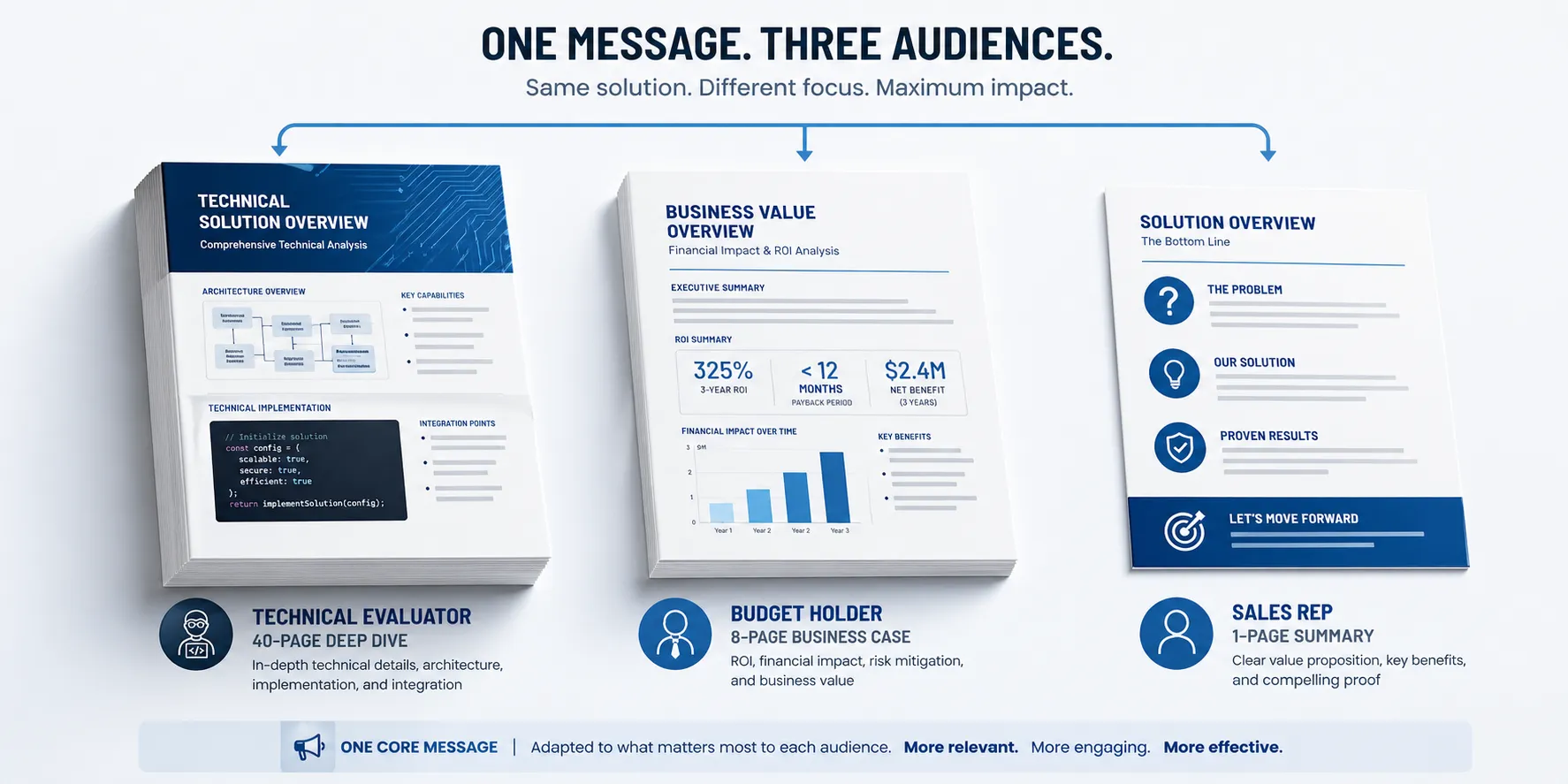
The ones converting deals fast? They structure white papers in three distinct formats. A technical deep dive for evaluators. An executive summary for budget holders. A one-page narrative for sales conversations.
The ones stalling? They ship one 40-page document and hope it works for everyone.
Here's what happens when you don't account for this.
A technical evaluator gets what they need. They're sold on the architecture, the methodology, the proof points. They recommend moving forward. But then that recommendation has to sell someone else. Someone who doesn't care about architecture. Someone who cares about risk, operational impact, budget impact.
That person reads the white paper. Gets lost in page 7. Asks more questions. Pulls in more stakeholders to align internally. Each one of those adds a week to your cycle.
Weeks turn into months not because your product is weak. Because the message wasn't built for the people who actually approve spend.
What Board-Level Buyers Actually Read
I've watched this happen enough times to know the pattern.
When a CFO or board member opens a security white paper, they're scanning for three things.
First: What's the business problem this solves? Not the technical problem. The business problem. Revenue risk? Operational downtime? Compliance exposure?
Second: What's the proof? Not the methodology. The proof. Case study. Benchmark data. Competitive comparison.
Third: What's the cost of action vs. cost of inaction? Not the price. The ROI. The business consequence of staying where you are.
Most white papers answer the first question halfway through page 8. Answer the second question across pages 15-25. Never directly answer the third question.
By then, your board-level reader is gone.
How to Rewrite Your White Paper for Different Audiences
This is where most security vendors miss the opportunity.
You don't need multiple white papers. You need one core narrative reshaped for different reading contexts.
Here's the structure that works.
For the Technical Evaluator:
- Keep your 40-page white paper
- Lead with technical architecture
- Deep methodology
- Proof points and benchmarks
- This person will read it
For the Budget Holder:
- Extract to 8-10 pages
- Lead with business impact
- How does this reduce risk? Improve uptime? Accelerate response?
- Include 2-3 case studies showing ROI
- Minimal technical detail
- This person will read this
For the Sales Conversation:
- One page or two
- Three sections: problem, solution, proof
- Designed to be pulled into a 20-minute meeting
- Rep can read it in 60 seconds, reference it in real time
- Sales rep will actually use this
The teams closing deals fastest all run this structure. They're not writing more. They're writing smarter.
The Real Cost of Getting This Wrong
Here's what happens when you don't account for audience.
You ship your white paper. Technical buyer is sold. They present to budget holder. Budget holder is confused. Asks more questions. Technical buyer has to re-explain. Message gets softer. Deal momentum dies.
That cycle repeats across every stakeholder in the buying process.
Each handoff costs you time. Each handoff is a chance for momentum to break.
The vendors winning? They eliminate the handoff problem because they built the message for each handoff from the start.
What to Do Monday Morning
Pick your last white paper. The one that should have converted but didn't.
Ask yourself three questions.
First: If a CFO opened this, would they understand the business impact in the first two pages? If not, rewrite the opening.
Second: Is there a case study that proves ROI? If not, add one.
Third: Could a sales rep pull a one-page narrative from this and reference it in a live conversation? If not, extract one.
That's your starting point. One white paper. Three formats. Same message. Different structure.
That's how you close faster.
Start a Conversation →