The Gap Between What Your CISO Knows and What Your CFO Understands (Where Deals Die)
Why security deals stall between CISO and CFO conversations. How to bridge the gap and close faster.
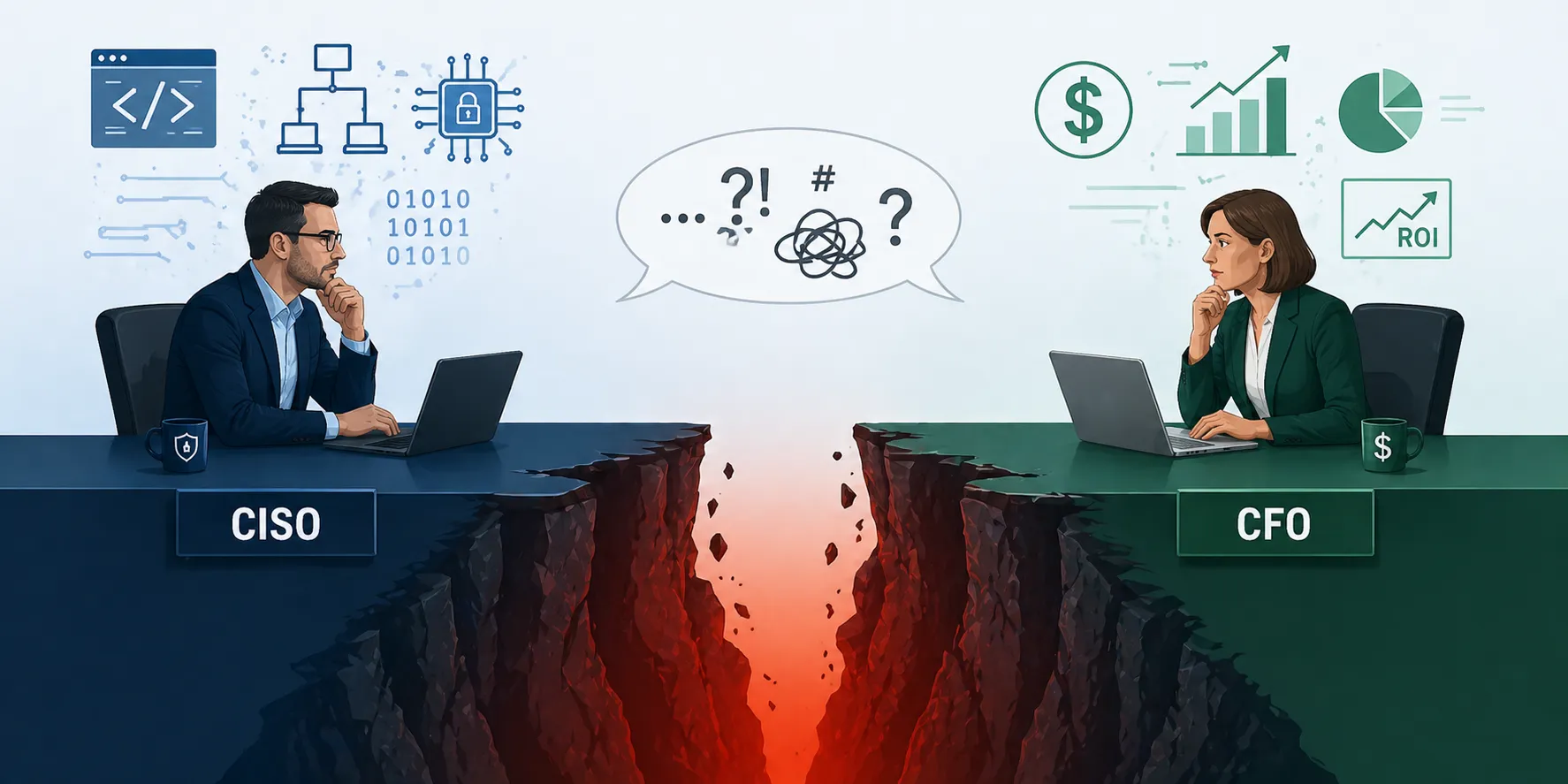
A CISO and CFO walk into a board meeting about security spending.
CISO: "We need to implement zero-trust architecture across cloud infrastructure. Current security posture has exposed accounts and misconfigured buckets creating lateral movement risk."
CFO: thinking "I understood zero-trust. Everything after that was noise."
CISO's right. The risk is real. The architecture is the solution. The CFO understands the stakes.
But somewhere between "zero-trust" and "lateral movement risk," the message broke.
That gap—between what security leaders know and what business leaders understand—is where most security deals die. Not because the product is weak. Because the translation failed.
The Pattern I'm Seeing
I've been analyzing how security vendors position to different audiences. The pattern is consistent.
When you talk to a CISO, you can use technical language. They know what you mean. They get the problem. They understand the solution.
When you talk to a CFO, that same language becomes noise.
Here's what usually happens.
CISO opens a white paper. Reads 30 pages of technical depth. Understands the architecture. Recommends moving forward to budget holder.
Budget holder reads the same 30 pages. Gets lost on page 4. Asks CISO to explain in business terms.
CISO translates. But something gets lost in the translation. Budget holder still doesn't understand the urgency or the ROI.
Conversation stalls. Deal stalls.
What Each Person Actually Cares About
This is where most security vendors miss the opportunity.
A CISO cares about:
- • Coverage
- • Architecture
- • Integration
- • Detection capability
- • Response automation
A CFO cares about:
- • Business risk
- • Cost of breach
- • Operational impact
- • Budget ROI
- • Competitive positioning
These are different languages. Different concerns. Different questions.
Most security vendors build messaging for one. Usually the technical buyer. Then hope it translates to the business buyer.
It doesn't.
Real Example: How This Breaks Down
I watched this happen last month with a real security vendor.
Vendor sells a detection engineering platform. CISO is sold. Platform reduces alert noise 60%. Speeds up detection. Integrates with their SIEM. Technical evaluation is clean. CISO recommends moving forward.
Now it goes to CFO. CFO gets a white paper designed for CISO. 35 pages on detection methodology. Alert tuning. Integration architecture.
CFO reads 4 pages. Asks: "What's the business case? How much does it cost? How much money do we save?"
White paper doesn't answer that question directly.
CISO has to translate. Says something like: "If we reduce alert noise, our team can respond faster and cover more ground with same headcount."
CFO thinks: "So I'm paying to optimize what we already have? Or am I paying to avoid hiring more people?"
Ambiguity. Decision stalls. Vendor loses the deal.
What Would Have Worked
A different approach from the beginning.
CISO gets:
The technical deep dive. 30 pages. Architecture. Integration. Methodology. Everything they care about.
CFO gets:
A one-page executive brief. Here's the problem. Here's the solution. Here's the ROI.
"Right now, your team spends 40% of time on false positives. That's $500K of salary annually spent on noise. This platform reduces false positives 60%. That's $300K back to the business. Your team can cover more ground. Respond faster. Incident response cost drops 40%."
Now CFO has a business case. CFO can evaluate on ROI, not on confusion.
CISO gets what they need. CFO gets what they need. Deal moves.
The Real Cost of This Gap
When messaging doesn't bridge CISO and CFO, deals stall.
But the cost is bigger than one deal.
Your sales cycle stretches. CISO has to spend time re-explaining. CFO has to ask more questions. More stakeholders get pulled in. Each one adds a week to close.
A deal that should close in 4 weeks takes 8 weeks because the message had to be translated at every step.
How to Fix This in Your Own Messaging
If you're a security vendor, audit your messaging right now.
Does your white paper answer both questions?
Question 1 (for CISO): Can this solve my technical gap? Does it integrate? Does it cover what I need?
Question 2 (for CFO): What's the business case? What's the ROI? What do I save?
If your messaging only answers question 1, you're losing deals.
If your messaging answers both from the start, you're closing faster.
Most security vendors answer question 1. The ones winning answer both.
That's where the gap is. That's where deals die. Close it, and your deals move faster.
Start a Conversation →