Why This Guide Matters
Enterprise deals don't stall because your product isn't good enough.
They stall because the content surrounding your product doesn't speak to the people who actually approve budgets, manage risk, and sign agreements.
This is the complete guide to technical content that moves enterprise buying committees — from white papers to executive briefs.
Related Pillar Content
Explore these complementary guides to build a comprehensive technical-to-business translation framework:
How Enterprise Buying Decisions Actually Work
Before you can create content that drives enterprise buying decisions, you need to understand what an enterprise buying decision actually is — because it is almost nothing like a transactional B2B purchase.
It's a committee, not a person
Enterprise buying is not one person making one decision. It is a group of people with different roles, different risk tolerances, and different definitions of success, arriving at a shared decision — often without ever being in the same room at the same time.
A typical enterprise buying committee in cybersecurity or fintech includes a technical evaluator (often a CISO, security architect, or engineering lead), a business evaluator (a VP of Operations, Head of Risk, or business unit owner), a financial approver (CFO or budget holder), a procurement or legal reviewer, and an executive sponsor who has final authority and the least time to spend on evaluation.
Each of these people will encounter your content at different moments, with different questions. None of them are reading your full white paper cover to cover. Most of them are receiving a summary from someone else. Your content needs to hold up through that chain — meaning the core argument has to survive multiple interpretations, re-framings, and translations between roles.
Technical validation is not the finish line
One of the most common mistakes vendors make is treating technical validation as the goal. They invest heavily in content that helps the technical evaluator understand the product — architecture docs, integration guides, technical white papers — and then wonder why the deal stalls after the POC succeeds.
Technical validation is the entry requirement, not the decision trigger. The deal moves when the business buyer is satisfied that the risk of adopting this vendor is lower than the risk of not acting. That is a business and financial argument, not a technical one. Content that only serves the technical stage leaves the rest of the buying committee without the materials they need to say yes.
Risk, budget, and timing are the real levers
Enterprise buying decisions ultimately come down to three variables: risk, budget, and timing.
Risk is the dominant factor in cybersecurity. Buyers are not asking "will this product work?" They are asking "what happens to us if we make the wrong call here?" — both the risk of a breach if they don't act, and the organizational risk of adopting a vendor that fails to deliver. Your content's job is to make the risk of inaction feel more concrete than the risk of adoption.
Budget is not just about price. It's about justification. A CFO approving a $400,000 security contract needs to explain that decision to a board. Your content needs to give them the language to do that. ROI frameworks, cost-of-breach analysis, operational efficiency numbers — these are not marketing extras. They are the tools that budget holders use to approve spending.
Timing is driven by external events: a regulatory deadline, a recent breach in the industry, a board-level mandate, an upcoming audit. Content that connects your product to a live business event dramatically reduces the time to decision. This is why threat intelligence reports and regulatory briefings are among the most powerful content formats in enterprise sales — they create urgency that your product description alone never will.
Internal champions carry the deal
Rarely does the person who first evaluates your product have the authority to approve it. Most deals move or stall based on the quality of your internal champion — the person inside the buying organization who understands the value of your product and advocates for it internally.
Your content is what your internal champion uses to make that case. A well-constructed executive brief, a sharp one-pager, a tight ROI summary — these are the tools your champion brings to the meeting you're not invited to. If your content doesn't exist in a format that can be forwarded, summarized in two minutes, and understood by someone who has never heard of your company, your champion will either make the case poorly or not make it at all.
Key Insight
Enterprise buying is a committee decision, not an individual one. Your content must serve multiple audiences simultaneously — technical evaluators, business stakeholders, and financial approvers — each with different questions and priorities.
Continue reading all 8 sections of this comprehensive guide
The Multi-Reader Problem: Why Most Technical Content Fails
The fundamental structural problem with technical content in enterprise sales is that it is almost always written for one reader and reviewed by many.
One document, six agendas
When a white paper is distributed inside a buying organization, it does not go to one person. It gets forwarded, excerpted, summarized, and discussed. A technical white paper written for a security architect will be skimmed by a CFO looking for the cost justification, reviewed by a legal team looking for liability language, and summarized for an executive sponsor who has four minutes before their next call.
Each of those readers will leave with a different impression. If the document only satisfies the technical reader, every other reader will either disengage or form an incomplete — and often unfavorable — picture of what you actually deliver.
The three audiences you must satisfy simultaneously
Effective enterprise content is built to serve three distinct audiences at the same time, without fragmenting the document or losing coherence.
The technical evaluator needs depth. They need to know that you understand the problem they're solving at a level of specificity that proves you've actually solved it. Vague claims of "industry-leading protection" do not move a security architect. Specific architecture decisions, integration approaches, and edge-case handling do.
The business evaluator needs translation. They can follow the technical argument, but what they're actually measuring is operational impact. How does this change what their team has to do every day? What does it eliminate, accelerate, or de-risk in their workflows? This reader needs the technical claims reframed in operational terms.
The executive approver needs a decision framework. They are not evaluating the product — they are evaluating the decision. Does the risk of moving forward outweigh the risk of not acting? Is this vendor likely to deliver and remain viable? Does the investment fit within the organization's strategic priorities? They need a short, clear, defensible argument — not a product description.
Most technical content fully satisfies the first audience, partially satisfies the second, and almost completely fails the third. That is why deals stall after technical validation.
The forwarding test
A simple way to evaluate whether your content is built for the multi-reader problem is what we call the forwarding test: if your internal champion forwards this document to the CFO right now, does it make the right impression on its own?
If the document leads with technical architecture, has no clear business outcome stated in the first two paragraphs, and requires background knowledge to follow — it fails the forwarding test. The CFO will skim the first page, conclude it's a technical document, and either ignore it or wait for someone to explain it to them.
Content that passes the forwarding test has a clear value proposition in the first 150 words, states the business problem before the solution, and has a section that can be read in under three minutes and still leave the reader with a complete argument.
The Translation Gap: From Technical Accuracy to Business Clarity
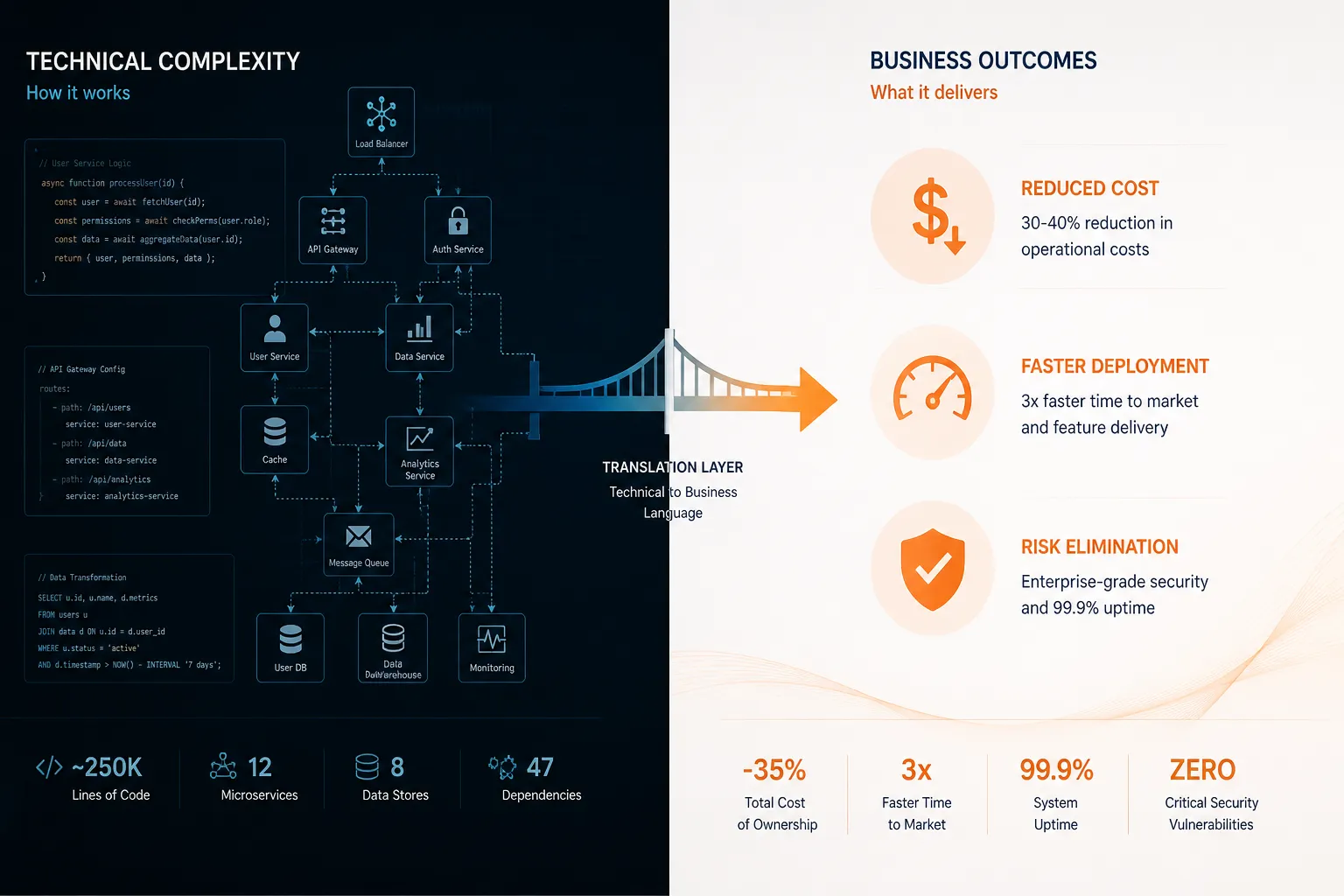
The most important skill in enterprise content — and the one that is rarest among technical vendors — is the ability to translate technical claims into business language without losing the underlying truth.
Why vendors get this wrong
Technical founders and marketing teams at technical companies tend to be deeply invested in the correctness of their product claims. This is a good instinct — accuracy matters. But it produces a specific pathology in content: the language of the product becomes the language of the content.
You get white papers that lead with the protocol architecture. Case studies that spend three paragraphs on the technical implementation before mentioning what the client actually achieved. Executive summaries that open with product feature lists.
The reader most affected by this is the business buyer and the executive approver — the two people who are actually going to approve the purchase. They're not hostile to technical content. They're capable of understanding it. But when technical language is the lead, they have to work to extract the business argument themselves. Most of them won't do that work. They'll move on.
What translation actually means
Translation is not simplification. It is not dumbing things down, removing technical detail, or replacing specificity with vague claims. Translation is resequencing — taking what is true about your product and presenting it in the order that a business reader can follow.
A technical claim: "Our platform uses graph-based behavioral analysis to detect lateral movement across hybrid cloud environments in real time."
A translated claim: "When an attacker gets inside a network, most security tools don't catch the movement between systems until damage is done. Our platform tracks how entities interact across the entire environment — cloud and on-premise — and flags unusual movement patterns before they become an incident."
Both statements are accurate. The second one is written for someone who needs to understand the business problem, not the technical mechanism. It leads with the threat, explains the gap in existing approaches, and then introduces the capability as the solution to a problem the reader already recognizes.
That sequence — problem, gap, solution — is the basic grammar of business-level technical content.
Three levels of translation
Not every piece of content needs the same level of translation. The right level depends on who the primary reader is.
Level 1 — Technical to operational: For business evaluators, the translation is from what the product does to what it changes in daily operations. Fewer manual processes. Reduced incident response time. Unified visibility across a fragmented environment. These are operational outcomes, and they sit one step above the technical mechanism.
Level 2 — Operational to financial: For budget holders, the translation goes one step further — from operational change to financial impact. Reduced breach cost. Compliance penalty avoidance. FTE-hours recovered. These are the numbers that appear in a budget justification, and they need to be in your content before the CFO asks for them.
Level 3 — Financial to strategic: For executive approvers and boards, the translation reaches the strategic level. This is about organizational risk posture, competitive positioning, regulatory resilience, and the long-term cost of inaction versus the cost of investment. At this level, the product almost disappears — what remains is the argument for why this decision matters.
Effective pillar content touches all three levels. Deep-dive cluster content can specialize.
Buyer Psychology and Why Deals Move or Stall
Content strategy is ultimately applied psychology. The decisions that enterprise buyers make — when to accelerate, when to delay, when to approve, when to walk away — are driven by predictable patterns of risk perception, social dynamics, and cognitive load.
Loss aversion dominates enterprise buying
Behavioral economics has established that people feel losses more acutely than equivalent gains. In enterprise buying, this plays out as a strong preference for inaction — because inaction feels safer than a decision that could go wrong.
The implication for content is direct: content that only describes what buyers will gain is less persuasive than content that makes the cost of inaction concrete. A threat intelligence report that quantifies the likelihood and cost of a breach in their specific industry sector is more persuasive than a feature comparison that shows why your product outperforms competitors. The first makes inaction feel dangerous. The second just makes your product look good.
This does not mean fear-based marketing. It means constructing the business case around the real cost of the problem, not just the value of the solution.
Status quo bias and how to disrupt it
Enterprise buyers are structurally biased toward the status quo. Changing vendors, adopting new platforms, and retraining teams all carry organizational friction that makes "keep what we have" feel like the safe choice — even when the status quo is clearly insufficient.
Content that disrupts status quo bias doesn't argue against the existing solution. It reframes the definition of the problem. If you can show buyers that the problem they think they've solved is actually a different, more significant problem than they've been treating it as — you shift their evaluation criteria, and suddenly the status quo is no longer adequate.
This is why original research — breach cost studies, benchmark reports, maturity assessments — is so powerful. It doesn't just describe a problem. It establishes new evidence that makes the buyer's current frame of reference look incomplete.
Social proof at the committee level
Individual B2B buyers use social proof heavily — case studies, analyst rankings, peer references. Enterprise committees use it differently. At the committee level, social proof is not about whether other companies use your product. It's about whether a company in a comparable situation, facing a comparable problem, made this decision and came out ahead.
This means your case studies need to be specific enough to map to the buyer's situation. A case study about "a large financial institution" reducing breach risk is generic. A case study about a mid-market fintech company operating under PCI DSS who reduced their audit prep time by 60% and eliminated three manual compliance workflows is specific enough to be forwarded to a buying committee as evidence.
Content Formats That Move Enterprise Deals
Different formats serve different moments in the buying process. Understanding which format belongs where — and why — is the foundation of a content system that consistently supports pipeline.
White papers
White papers are the workhorse of enterprise technical content. At their best, they establish category authority, educate a buying committee on a problem space, and frame your approach as the logical response to a well-documented challenge.
A white paper written for enterprise sales has a specific structure: it opens with the business problem, not the product. It provides enough technical depth to satisfy the evaluator while maintaining readability for the business audience. It ends with a clear framework for how organizations should evaluate solutions — a framework that, not coincidentally, your product satisfies.
White papers fail when they are written as extended product brochures. If the document reads like a capabilities overview with citations, it will not function as a credibility-building asset. The test of a good white paper is whether it would be worth reading even if your product didn't exist.
Executive briefs
An executive brief is two to four pages. It is written for the person who will make or approve the final decision and has the least time to spend on it.
It opens with the strategic context — why this decision matters now. It summarizes the key risk or opportunity in business terms. It describes the decision the organization needs to make. And it provides a clear, defensible recommendation.
Executive briefs are not summaries of longer documents. They are standalone arguments designed for a specific reader in a specific role. They should be able to be read in under five minutes and leave the reader with a complete picture of why this matters and what they should do.
Threat intelligence reports (cybersecurity)
Threat intelligence reports are among the most powerful content formats in cybersecurity sales because they create urgency before a vendor conversation begins. A well-constructed threat intelligence report — covering a specific threat category, industry sector, or attack surface — positions your company as a credible authority on the problem and establishes the stakes of inaction before you've mentioned your product.
The best threat intelligence reports include original data or analysis, not just aggregated industry statistics. They are specific to the reader's industry. They are written at a level that a CISO can cite in a board meeting, which means they are technically accurate and clearly written at the same time.
Case studies
Case studies are proof assets. Their job is to take the abstract claims in your other content and make them concrete and credible through a specific example.
The structure that works in enterprise sales is not the standard marketing case study format. The effective format opens with the business situation, not the company background. It describes the specific problem at the level of detail that makes a similar buyer recognize their own situation. It covers the decision process — including what was evaluated and why your approach was selected. And it ends with specific, quantified outcomes wherever possible.
Vague outcomes ("improved security posture," "faster response times") are nearly worthless. Specific outcomes ("reduced mean time to detect from 47 hours to 4 hours, eliminated 3 FTE-equivalents of manual monitoring work") are the difference between a case study that gets forwarded and one that gets ignored.
Benchmark and research reports
Original research is the highest-authority content format available to a technical vendor. It establishes credibility that no amount of product marketing can achieve, because it provides value independent of your product.
Benchmark reports, maturity model assessments, and industry surveys work because they give buyers a way to evaluate their own position — and in doing so, establish your company as the authority on the problem space. If your research defines how buyers think about the problem, you've already shaped the evaluation criteria before the formal buying process begins.
One-pagers and sales leave-behinds
One-pagers are what your internal champion uses in the meetings you're not invited to. They are not brochures. They are structured arguments compressed into a single page.
A one-pager that works in enterprise sales states the problem in the first sentence, frames the business impact in the first paragraph, summarizes the solution approach in three to five lines, includes one specific proof point (a statistic, a client outcome, or a third-party validation), and ends with a clear next step.
The test: can someone who has never heard of your company read this, alone, in two minutes, and come away with a clear understanding of what problem you solve, why it matters, and why you're the right choice?
Sales Enablement: Where Content Meets Pipeline
Creating strong content is only half the problem. The other half is ensuring it reaches the right person at the right moment in the sales cycle — and that your sales team can actually use it.
Why sales teams don't use most marketing content
The gap between content production and content usage is one of the most consistent failures in B2B marketing. Sales teams receive a steady output of white papers, case studies, and blog posts that never make it into customer conversations. The reasons are predictable.
Content is written at the wrong level. A white paper written for a technical evaluator is not useful in a conversation with a CFO. A one-pager written for a general audience doesn't address the specific objection that came up in the last call.
Content is not organized by use case. When a sales rep needs something to address a specific objection or advance a specific stage of the deal, they need to be able to find it in 30 seconds. A content library organized by format or date is essentially unusable under those conditions.
Content is not written for conversation. Marketing content is often written to be read, not to be referenced in a live discussion. Sales teams need content that gives them language — a stat to cite, a framing to use, an analogy to draw on. That requires a different kind of writing.
Mapping content to buying stages
The content system that consistently supports pipeline maps specific assets to specific moments in the buying process.
Awareness and first contact: Threat intelligence reports, original research, and thought leadership that establishes credibility before a vendor conversation begins. This content is not sales content — it functions as credibility infrastructure that makes the first conversation easier.
Early evaluation: White papers, technical guides, and detailed case studies that help the technical evaluator understand your approach and begin building an internal case for further evaluation.
Active consideration: Executive briefs, ROI frameworks, and comparison materials that serve the business evaluator and budget holder as the deal enters formal review.
Late-stage and committee review: One-pagers, concise executive summaries, and specific proof assets (case studies, references, certifications) that give the internal champion the materials to make the case in the final review meeting.
Post-decision: Onboarding content, implementation guides, and early success documentation that reduces buyer's remorse and accelerates time-to-value — which directly impacts renewal and expansion.
Content that travels
The most valuable sales content travels well. It can be forwarded without context. It can be summarized verbally in two minutes. It can be read by someone who knows nothing about your company and still make a coherent argument.
This is the standard that enterprise sales content needs to meet — and it is almost never the standard used to evaluate content in production. Most content is evaluated for accuracy and completeness. The better evaluation criteria are: can this be forwarded? Can it be used in a meeting I'm not in? Does it make the right impression on someone who didn't ask for it?
Cybersecurity and Fintech Content: Industry-Specific Dynamics
The principles in this guide apply broadly to technical B2B companies. But cybersecurity and fintech have specific dynamics that shape how content needs to be constructed.
Cybersecurity: the stakes problem
Cybersecurity content operates in a specific emotional register that most other technical categories don't. The stakes — data breaches, regulatory penalties, operational disruption, reputational damage — are existential in a way that, for example, infrastructure software rarely is.
This creates a specific content challenge: the temptation to lead with fear is strong, and the market is saturated with threat-focused content that has long since lost its ability to create urgency. Every security vendor produces threat reports. Every vendor talks about the sophistication of the modern threat landscape. The baseline anxiety is already priced in.
What moves cybersecurity buying decisions in this environment is specificity. Not "threats are increasing" — but "organizations in your sector experienced a 34% increase in supply chain compromises in the past 18 months, and 61% of those incidents originated from a third-party integration your team almost certainly has deployed." That is the level of specificity that creates a distinct, addressable sense of urgency rather than adding to a general background noise of threat awareness.
Cybersecurity content that drives buying decisions also speaks clearly to the business impact of security events — not just in technical terms, but in financial, operational, and reputational terms. The CISO may be your initial evaluator, but the buying decision is made by people who are measuring risk against business continuity, regulatory exposure, and organizational resilience.
Cybersecurity: the compliance layer
Compliance is a major driver of cybersecurity purchasing — and it creates a specific content opportunity. Organizations buying security solutions are often buying under the pressure of a regulatory requirement: SOC 2, ISO 27001, DORA, NIS2, PCI DSS, HIPAA, or others depending on sector and geography.
Content that maps your solution directly to compliance requirements — explaining not just that you "support compliance" but specifically which controls you satisfy, how the audit process is affected, and what the operational burden looks like before and after — speaks directly to one of the most concrete, deadline-driven motivators in enterprise security buying.
Fintech: the trust and credibility problem
Fintech vendors face a different but equally specific content challenge: the buying audience has extremely high standards for financial and technical credibility, and is acutely sensitive to content that sounds like it's oversimplifying a complex domain.
A content asset that feels like it was written by a marketing team rather than someone with deep financial domain expertise will not survive a fintech buying committee. The CFO and CRO in a financial institution can immediately identify content that uses industry language without genuine understanding behind it. This means fintech content has to earn credibility on two dimensions simultaneously: financial domain expertise and technical rigor.
The most effective fintech content demonstrates genuine understanding of the specific operating environment — regulatory pressures, market structure, operational constraints, risk frameworks — and then introduces the solution as an answer to a problem that is clearly understood from the inside.
Fintech: the infrastructure communication challenge
Financial infrastructure is by nature highly technical, highly regulated, and difficult to communicate to the business stakeholders who approve spending on it. A payments infrastructure vendor, a core banking platform, or a risk analytics system faces the challenge of explaining what their product does in terms that a CFO or Chief Risk Officer can evaluate — even though the actual mechanism is deeply technical and the risk of a shallow explanation is creating misplaced confidence in something being misunderstood.
This requires a specific kind of content architecture: technical depth available on demand, but not leading. Executive-level materials that state business outcomes clearly. Implementation content that is honest about what adoption actually requires. And risk-framing content that helps the buyer understand both the upside and the transition cost of adoption.
Building a Content System for Enterprise Sales
Individual pieces of strong content are not enough. Enterprise buying cycles are long — often six to eighteen months for significant deals — and a single well-written white paper will not sustain a vendor's credibility and presence throughout that process.
What moves deals across that timeline is a content system: a set of interconnected assets, built around a consistent point of view, that serves different audiences at different stages and compounds in authority over time.
What a content system is not
A content system is not a content calendar. Producing a regular cadence of blog posts, social updates, and press releases is not a content system — it is a production schedule. The distinction matters because production schedules optimize for output, while content systems optimize for outcomes.
A content system is also not a content library. Having a collection of white papers, case studies, and one-pagers does not constitute a system unless those assets are connected — in argument, in audience mapping, and in the way they are deployed across the sales cycle.
The architecture of an enterprise content system
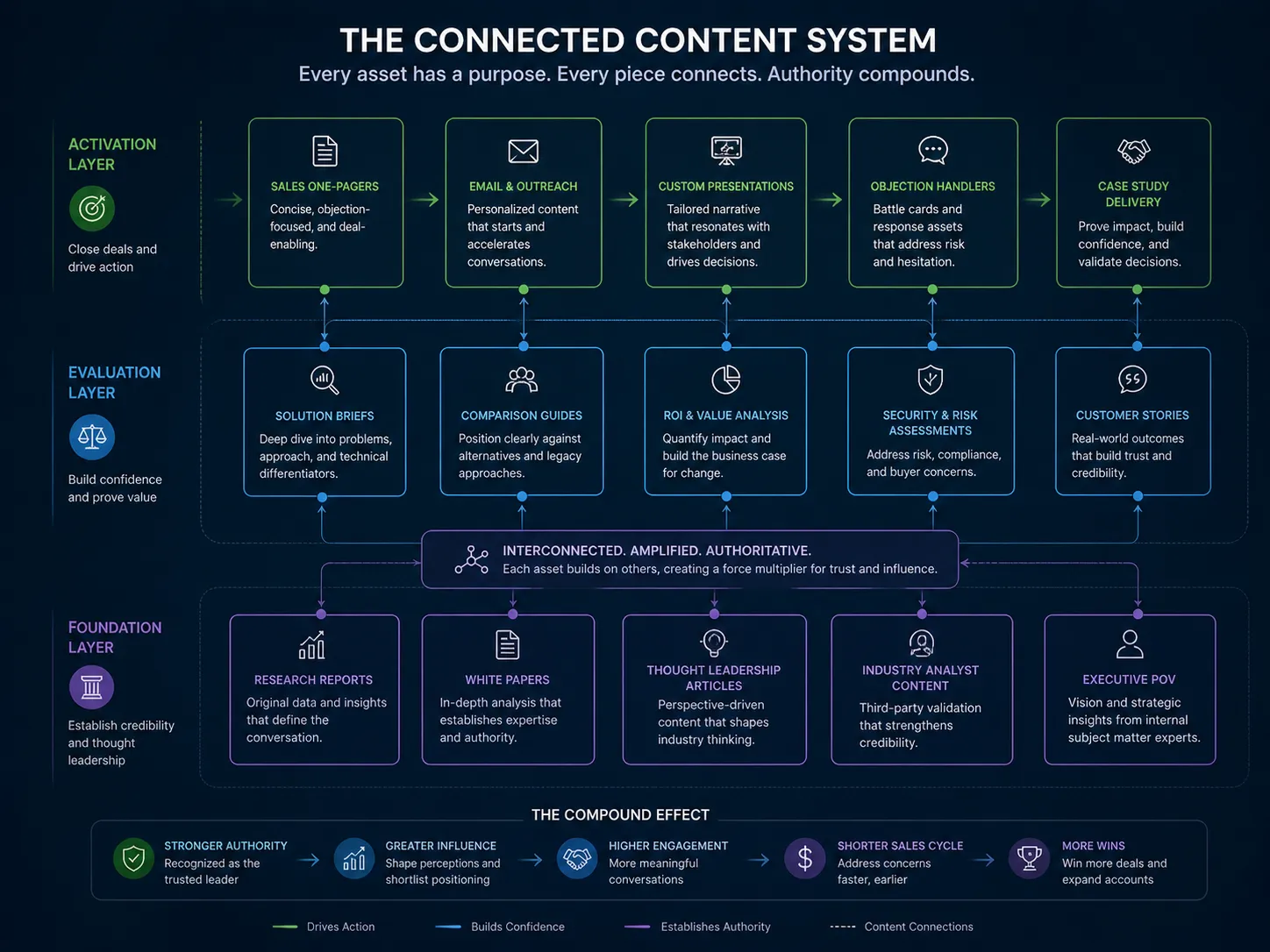
An effective content system for enterprise sales has three layers.
The foundation layer is your point-of-view content — the research, analysis, and perspective that establishes your credibility on the problem space before any product conversation begins. This includes original research reports, industry analysis, benchmark studies, and the kind of thought leadership that gets cited by other content. This content builds the authority that makes everything else more credible.
The evaluation layer is your sales-stage content — the white papers, technical guides, case studies, and ROI frameworks that serve buying committee members as they evaluate your solution. Each asset in this layer is mapped to a specific audience and a specific stage of the buying process.
The activation layer is your conversation content — the one-pagers, executive briefs, and sales scripts that your team uses in direct interactions with buyers. This content is designed to travel, to be used in meetings you're not attending, and to give your internal champion the language they need to make the case.